Latest updates
Seasonal reading with Kate De Goldi
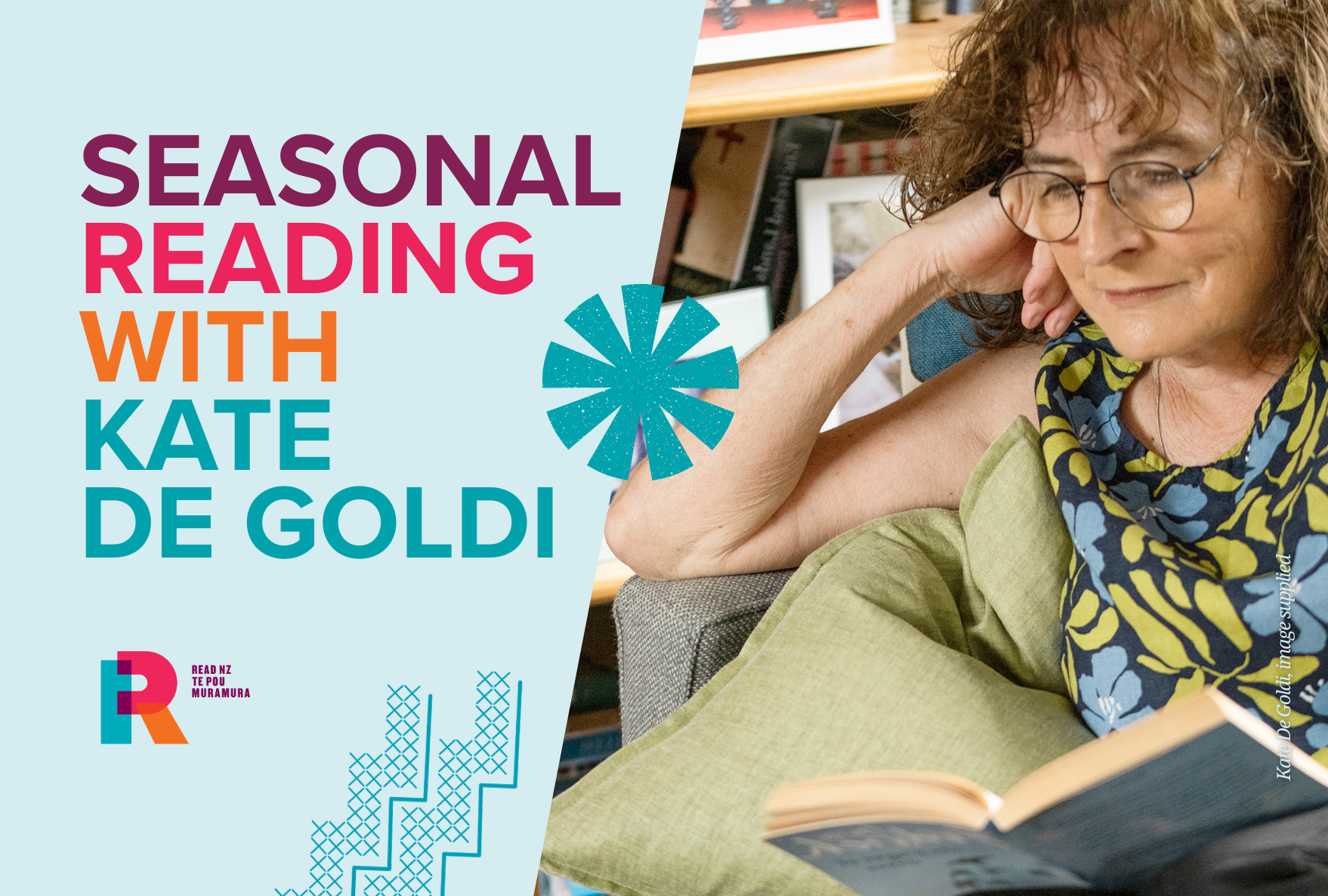
A new series where we ask reading champions in Aotearoa New Zealand to talk about the books that made them a reader. In this edition, follow Kate into the pages of Louise Erdrich.
Seasonal reading
During my sixteenth summer, I read my way through John Galsworthy’s Forsyte Chronicles. The novels explore three generations of a starchy, complacent, upper middle-class English family confronting rapid social change in the early years of the 20th century.
I don’t remember what prompted me to these books, except that they were there, along with all the others on the living-room bookcase. I’d bet, though, that a considerable attraction was the number of books – nine!, enough for weeks of reading: in short, a series. The pleasures of series were a big part of my childhood reading – beginning with The Bobbsey Twins, an apparently limitless stream of (objectively, crummy) books authored by a syndicate of writers; on through Beverley Cleary’s Henry Huggins books (very funny), the Narnia stories, and my enduring favourite – The Mantlemass Chronicles by Barbara Willard, sublime historical novels about two families of foresters in south-east England, from the Battle of Bosworth to the end of the Civil War.
All compulsive readers know the best thing about a satisfying series is the feeling of (almost) never running out. No creeping anxiety as a book is coming to an end, because, yes! there are five, eight, fifteen more books to come. The setting, the people, the voice and the vibe, keep on reliably being there. Can there be anything better than stumbling on a promising crime or sci-fi or fantasy series that already has a substantial backlist?
With multi-volume chronicles there are the additional pleasures of watching characters bloom and recede, centre stage in one book, a bit part in another – an approach that offers multiple interpretations of events, relationships, motives, secrets. The characters become a solid presence in your life, a magnetic alternative reality that keeps on giving. The Forstyes are with me still, forever talking past each other in London drawing rooms, on London streets – but seasoned, too, with the sensory mashup of a 1970s Christchurch summer: Coppertone sunscreen and apple-scented shampoo, the Sex Pistols, beetroot sandwiches, hot sand and sea breeze.
As the weather turns, the promise of the coming months seems boundless – it’s the perfect time to explore a writer new to you; even better, a new writer who has for decades been chronicling the fluctuating fortunes and backstories of one family, across time and place and shifting social-political landscapes.
Louise Erdrich and her Love Medicine novels will supply weeks and weeks of immersive pleasure, sorrow, and startlement.
Erdrich is of Ojibwe and German descent, a leading voice in the second wave of Native American writing and much garlanded. She has published 19 novels, books of poetry and non-fiction, and novels for children.
Her first novel Love Medicine, (1984) begins a series that explores the entwined and complicated Kashpaw-Nanapush-Lamartine-Pillager families, on their North Dakota reservation and in the neighbouring town of Argus. The story begins in 1981 with the death of June Kashpaw, a desperate, willed departure in a snowstorm. The snow fell deeper that Easter than it had in forty years, but June walked over it like water and came home. The family gather to farewell this beloved but troubled aunt-daughter-niece-mother, born into one family but reared by another, (a Native custom akin to whāngai.) From here, Erdrich takes us back to the 1930s, to the family patriarch Nector Kashpaw’s fateful meeting with Marie Lazarre, and the baleful influence of Sister Leopolda, a mixed-race Catholic nun, whose presence over several novels is quietly terrifying.
This is a brilliantly controlled polyphonic narrative, moving backwards and forwards through the decades, spending time with characters from several generations, some who will figure at different points in their lives across eight books: Lulu Lamartine, mother of eight sons by several fathers and rival to Marie Lazarre; Nanapush the trickster elder; his and Lulu’s activist son, Gerry, fugitive, then incarcerated for fifty years; cousins, Lipsha, Lyman, King, and Albertine, wrestling with their families’ slippery narratives, and the legacy of colonisation, Federal persecution, neglect, and erasure.
Erdrich is heir to both the English realist novel tradition and Native oral story which accommodates the mythic and shamanic. Her novels are richly sensuous and her prose hypnotic – the right side of lush (‘precise lyricism’, in the words of one reviewer). They pay close attention to deep local history, the characters’ relationships with land and fauna, the eternal struggle to reclaim sovereignty in their own country, and the ongoing tussle with modernity – how to reconcile Puritan rationalism with an intuitive, animist interpretation of events and relationships.
The books are compulsive reads, full of incident, estrangement, reconciliation, extravagant passions, and moments of great beauty and calm. There is life in all its softer colours too – food, song, parties, business plans, tiffs, courtship, play. Also a good deal of antic behaviour and comedy. And Erdrich’s evocation of the Great Plains landscape and its dramatic weathers is a wonder.
Tracks, the third novel, takes place between 1912 and 1922 during a time of multiple deaths from disease and famine. Narrated alternately by Nanapush and Pauline Puyat (later Sr Leopolda), it has an astonishing account of Eli (brother of Nector) deep in wintery forest with a moose he has shot and must somehow carry a long way home.
He butchered carefully, but fast as possible … then quickly cut off warm slabs of meat and bound them to his body with sinew so that they would mold to fit him as they froze… jagged ovals of haunch meat to thigh … smaller rectangles down his legs, below the knees. He pressed to himself a new body, red and steaming …
Nanapush’s narrative is addressed to his adopted daughter, the magnetic Fleur Pillager, who has resisted the encroachments of white culture and lives an isolated, self-sufficient life on family land. She may or may not have magical powers – a string of strange, violent incidents occur as a consequence of her rage following a sexual assault by white men in the town of Argus.
Pauline-Leopolda – a character at war with her Native inheritance, jealous of Fleur’s power and the admiration she inspires – narrates the series of events that bring her to the convent and the decision to become ‘a bride of Christ’. Fleur and Leopolda are towering figures, embodying the twin poles of light and dark at work in the stories. Leopolda’s tale reaches its climax in the fifth novel, Tales of Burning Love, but she also has a major role in the story of Father Damien and his lifelong secret, The Last Report on the Miracles at Little No Horse. Fleur and Nanapush are there too, arguing ceaselessly against land alienation and government mendacity.
The Beet Queen, the second novel, moves sideways to tell the story of Mary & Karl Adare, children who arrive in Argus from California in 1932 after their mother has abandoned them, flying off in a hot-air balloon with The Great Omar. It says something for Erdrich’s powers that this surreal incident feels utterly convincing.
Karl and Mary become separated but their stories are also related in tandem. Mary is taken in by her German aunt and uncle and works in their butcher shop business. Karl wanders, searching for an identity, exploring relationships with both men and women. Eventually, the siblings are reunited and come to know a Kashpaw cousin, Celestine James, with whom Karl has a child, Dot, who in time will marry the activist Gerry Nanapush. Meanwhile, Karl and Mary’s month-old baby brother – hocked off by Karl to a childless couple on the evening their mother disappears over the horizon – grows up to become Father Jude who plays a key part in The Last Report.
Confused? Don’t be. The enmeshed relationships and the heavily deferred revelations of secrets and suppressed lives are enormously satisfying. Also, happily, in newer editions of the books Erdrich has supplied family trees. I’ve often studied these genealogies, so byzantine are the interconnections; once you get to this level of investigation you’ve become so invested it’s as if you’re penetrating the mysteries of your own family.
These are just some of the titles in the Love Medicine chronicles and it may be there are more to come. Erdrich is prolific and instinctively digressive. In the last two decades she has produced the ‘justice’ trilogy, novels of contemporary lives, exploring themes of violence, guilt, vengeance, and forgiveness. And then there’s her spellbinding children’s series, the five Birchback House novels, drawing on the history of her Ojibwe ancestors in the 19th century.
Erdrich has described this series as both a salute and a corrective to the Little House on the Prairie books by Laura Ingalls Wilder. It is the shadow story of white settler movement across the American continent. The Ingalls family’s travel from Wisconsin to Kansas, through Minnesota & Iowa to their final destination Dakota, describes the ‘covered wagon’ migration across the Great Plains – thousands of settlers who displaced Native Americans, disenfranchising them of their land, food resources, and historical touchstones.
The story of Omikayas and her family is an excellent read aloud: there’s adventure, mischief, anxiety, family comfort and endurance alongside the arresting beauty of place and the wonderment of a child’s growing years.
The Love Medicine series needn’t necessarily be read in order of publication, but I think this approach yields the most satisfaction. The illuminations and elaborations of the characters’ histories and secrets, read in the order the author intended, deliver quite the wallop and shiver. And an immediate desire to reread the earlier books. Double your money, you might say.
The Love Medicine Chronicles
Love Medicine (1984)
The Beet Queen (1986)
Tracks (1988)
The Bingo Palace (1994)
Tales of Burning Love (1997)
The Last Report on the Miracles at Little No Horse (2001)
Four Souls (2004)
The Painted Drum (2005)
The ‘justice’ series
The Plague of Doves (2008)
The Round House (2012)
La Rose (2016)
Stand-alone novels
The Antelope Wife (1998) revised and republished as The Antelope Woman (2009)
The Master Butchers Singing Club (2003)
Shadow Tag (2010)
Future Home of the Living God (2017)
The Night Watchman (2020)
The Sentence (2021)
The Mighty Red (2024)
The Birchbark House series
The Birchbark House (1999)
The Game of Silence (2005)
The Porcupine Year (2008)
Chickadee (2012)
Makoons (2016)
About Kate
Kate De Goldi is the current Te Awhi Rito New Zealand Reading Ambassador, who advocates for and champions the importance of reading in the lives of young New Zealanders. She is a writer, a dedicated reader and a long-time advocate for the importance of reading at every stage of life.
Kate reviews books in print and broadcast media, and teaches creative writing at schools throughout New Zealand. With Susan Paris, she is co-publisher of the Annual Ink children’s imprint.